
State Museum-Reserve “Samarkand”
The objectives of the museum are to provide a comprehensive and objective presentation of the rich cultural and historical heritage of the people, to reveal its significance in the history of humanity, and to create museum exhibitions aimed at promoting the country’s achievements in the political, social, economic, and cultural spheres.
A key objective of the museum is the preservation, study, and systematic enrichment of museum collections, their wide presentation to domestic and international audiences, as well as fostering among visitors—especially the younger generation—respect for national and universal values, the unique historical and cultural heritage, a sense of pride in the past, patriotism, and a conscious love for the Motherland.
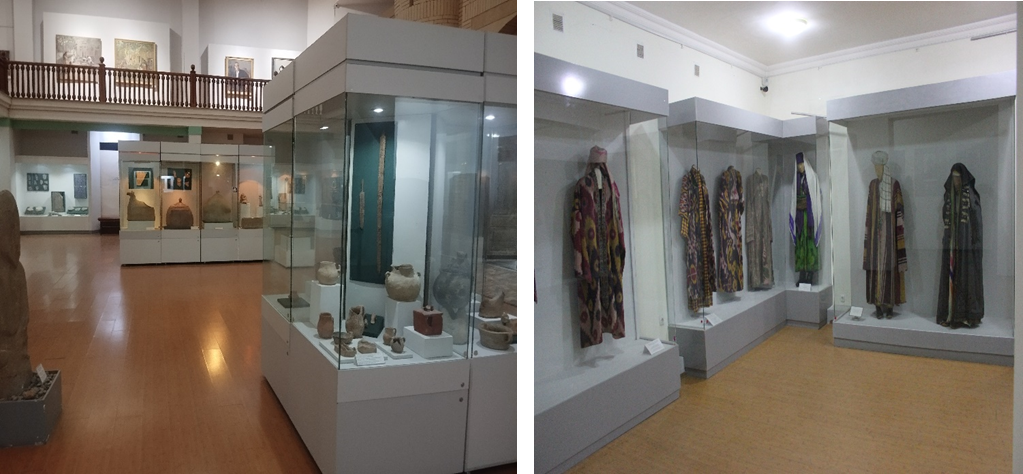
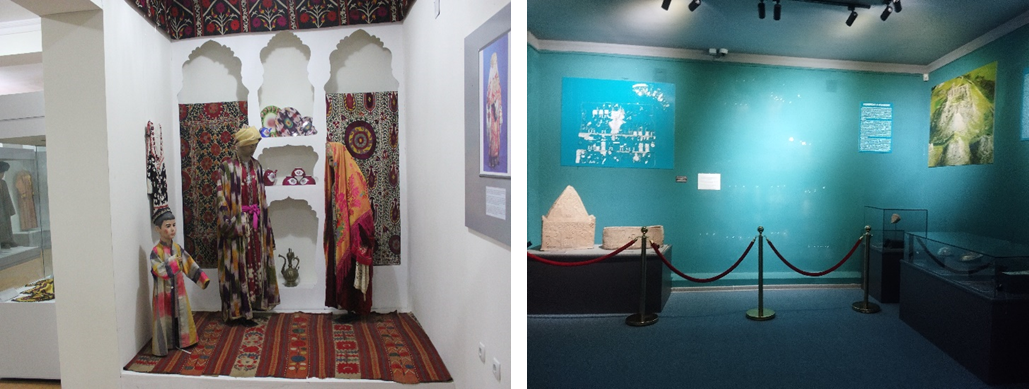
Primary Functions of the Museum include:
- strengthening scientific research on museum objects and collections of the museum-reserve and regularly publishing the results of such research;
- extensive use of modern information technologies in the development of museum exhibitions;
- organization of scientific and practical conferences on актуальные issues of museology and dissemination of best practices;
- organization of joint exhibitions with foreign museum-reserves and strengthening mutually beneficial partnerships;
- establishment of a scholarly and artistic council at the museum-reserve with the involvement of scholars and specialists;
- organization of thematic expeditions aimed at enriching the museum-reserve collections;
- creation of necessary conditions for the implementation of advanced international museum practices and other areas of activity.
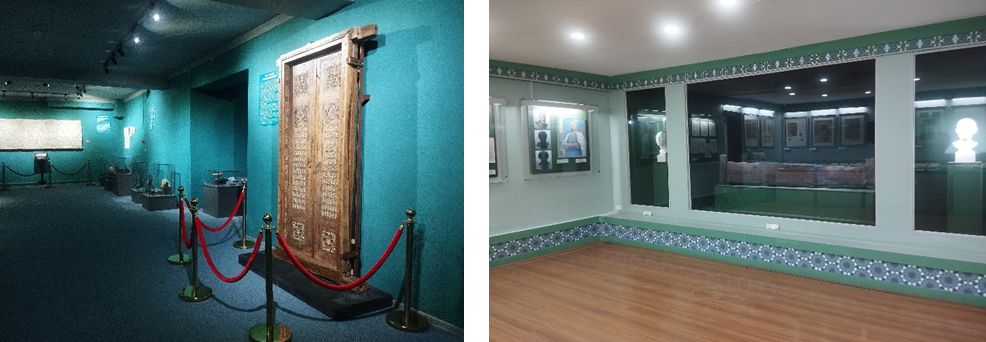
History
The history of the formation of the State Museum of the History of Culture of Uzbekistan dates back to 1874. After the conquest of Samarkand by the Russian Empire in 1868, a collection was formed within the chancery of the Samarkand Governor-Generalship, which was officially opened as a museum on July 21, 1896.
Initially, the museum was housed in the building of the Church of St. George. At the beginning of the 20th century, a special building was constructed for the museum and reading hall (currently the building of the Children’s Information and Resource Center). Since 1923, the museum has operated in a building constructed by the Samarkand merchant Abram Kalontarov. From the 1970s onward, the museum continued its activities in the building located at 1 Registan Street (now Islam Karimov Street).
In 2009, the museum was relocated to an adapted building at 148 Mirzo Ulugbek Street, Samarkand. The museum-reserve’s holdings contain more than 235,000 exhibits. Since 2013, permanent museum exhibitions have been on display in this building.
Exhibits and Artifacts
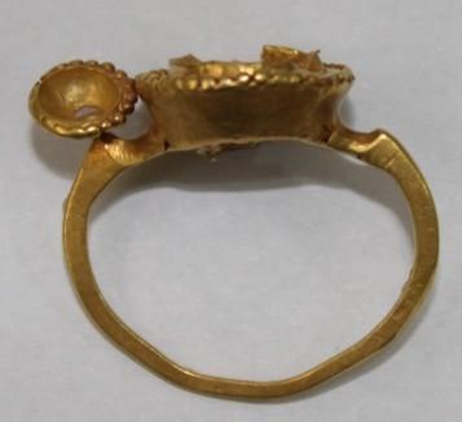
Earring
A ring-shaped earring, one end of which features an oval expanded section (flared end). Along the edge of the flared part there is a through hole into which the tapered opposite end of the ring is inserted. The ring has an irregular oval shape. The edges of the flared section are uneven, with minor damage observed in some areas. Dated to the 10th century BCE. Found in a burial in the village of Muminobod, Samarkand region. Transferred to the museum on February 25, 1967, by A. Askarov, Institute of Archaeology of the Academy of Sciences of Uzbekistan, Samarkand.
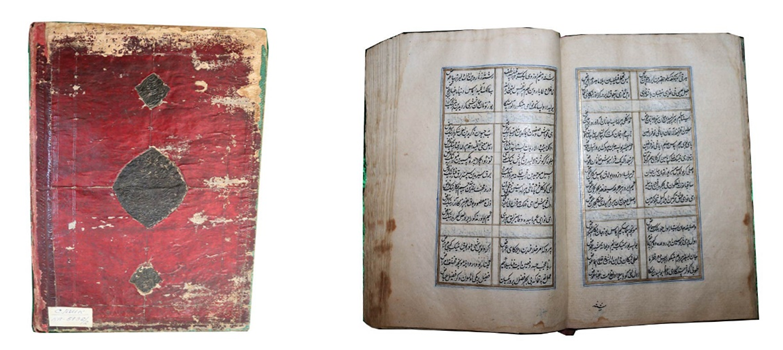
Zakariya al-Qazwini. “ʿAjāʾib al-Makhlūqāt”
The work belongs to the fields of geography, biology, and natural sciences. It describes representatives of the animal and plant worlds, their habitats, role in society, benefits and harms, as well as medicinal properties. The manuscript is decorated with colored illustrations.
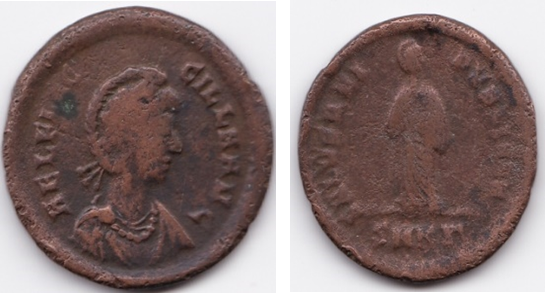
Roman Empire. Empress Flaccilla (†388)
Bust of the empress facing right. The legend depicts a standing female figure (Salus—Health). An inscription is present beneath the image. Inventory weight — 4.91 g; actual weight — 4.89 g.
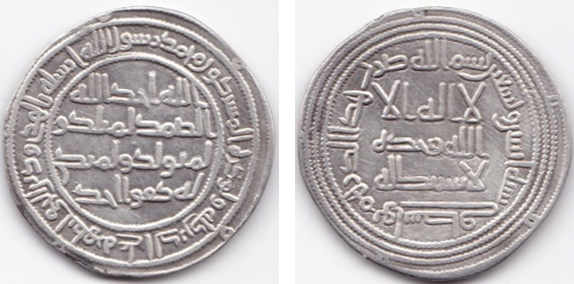
Umayyads — Eastern Caliphate
ʿAbd al-Malik (during the reign of al-Walid I), AH 86–96 / 705–715 CE. Dirham weighing 2.92 g, minted in the city of Wasit. Arabic inscriptions are present.
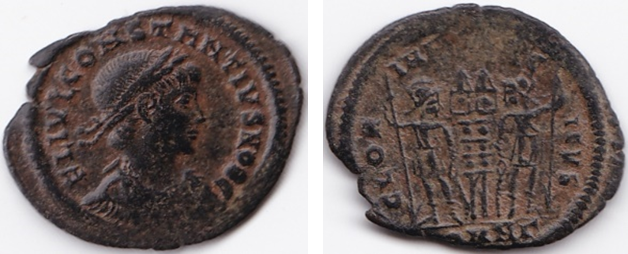
Roman Empire. Honorius (393–423)
Bust of the emperor wearing a diadem and cloak, facing right. The legend depicts Victory crowning a warrior with a laurel wreath.
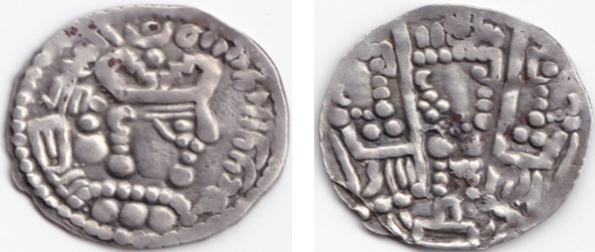
Bukhar Khudat. Issued in the name of Caliph al-Mahdi
AH 158–169 / 775–785 CE.
Obverse: a bust similar to that of Varahran V, crowned and facing right; three zero marks below the shoulder line.
Reverse: a fire altar with a bust depicted in the background; guards holding swords on both sides, their faces turned toward the fire. The edge is damaged; inscriptions are absent.
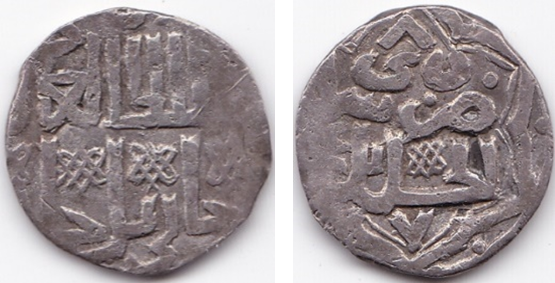
Golden Horde — Jochid Dynasty. Khan Janibek
AH 741–756 / 1341–1355 CE. Dirham minted in Saray al-Jadid in AH 748 / 1348 CE. Arabic inscription: “The Just Sultan… Janibek Khan.” The composition is executed in the form of a decorative hexagon.
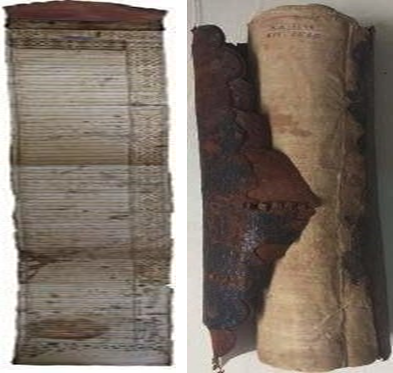
Waqf Deed
A document relating to the property of a Bukhara resident named Bohovoddin. Compiled in AH 1105 (1693 CE) on thick glossy paper, written in large and elegant nastaʿliq script in ink and gold, mounted on thin cotton fabric. Decorated with vegetal ornamentation and bearing 95 personal seals. State of preservation: cracks, moisture stains, and traces of wear are present.
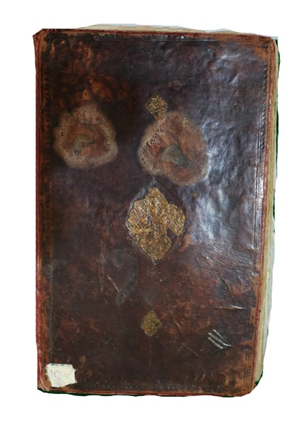
Nizami Ganjavi. “Khamsa”
A manuscript collection of poems by the renowned Azerbaijani poet. The text is arranged in four columns and copied in elegant nastaʿliq script.
“Khosrow and Shirin” — folios 9a–73a. The text is arranged in four columns and enclosed within decorative frames made of gold and colored lines. The headings are written in ornate panels embellished with gold (a total of 103 panels).
The work begins with the chapter “Raftani Shirin va chashma va dar ob nishastan” (“Shirin’s journey to the spring and her bathing”) and concludes with “Daridani Khosrow nomayi Hazrati Rasulro” (“On Khosrow tearing the Prophet’s letter”).
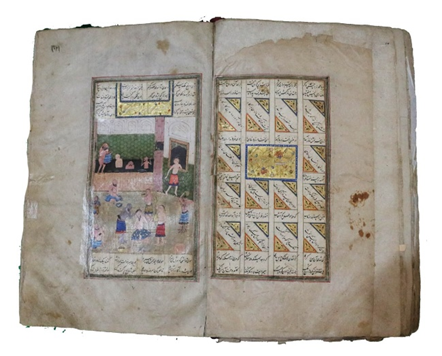
The beginning and end of the manuscript text are decorated with three miniatures:
– Shirin returning from a прогулка (folio 17a);
– Khosrow observing Shirin while she bathes (folio 23a);
– a scene in which Shapur (Khosrow’s servant) informs Shirin about Khosrow during a banquet (folio 35a).
In total, the manuscript contains 10 miniatures, 4 frontispieces, and 315 decorative panels. The binding is lost and survives in a fragmented, deteriorated condition.
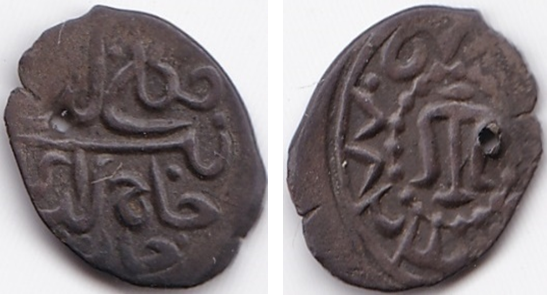
Crimean Khanate, Giray Dynasty. Mengli Giray
AH 873–921 / 1468–1515 CE. Minting place presumably Kyrk. Inscription: “Mengli Giray, son of Haji Giray Khan.” The coin was minted in AH 882.
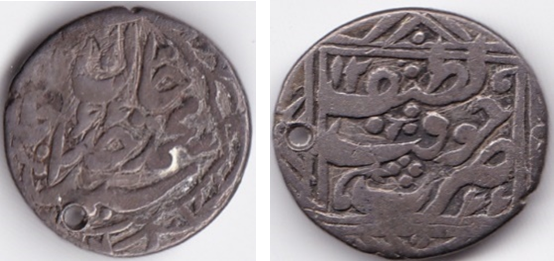
Kokand Khanate. Muhammad-Khudayar Khan (first reign)
AH 1266. Tenge minted in Kokand. Arabic inscription indicates the khan’s name and the year of minting.
Permanent Exhibitions
– “History of the Study of the Mausoleum of Amir Temur”;
– “Uzbekistan at the Crossroads of World Civilizations”;
– Exhibition dedicated to Independence;
– “Treasures of the Oases of Uzbekistan: At the Crossroads of Caravan Routes”;
– “History of the Emergence of Writing in Central Asia”;
– “P. Benkov and His Artistic School”;
– “Boysun Bahori”;
– “National Costumes of the Peoples of Uzbekistan in the Late 19th – Early 20th Centuries”;
– “Jewelry Art of Uzbekistan”.
Visitor Information
Opening hours: daily from 09:00 to 17:00 (no lunch break).
Address: 148 Mirzo Ulugbek Street, Samarkand, Samarkand Region, Republic of Uzbekistan.
Contacts (Telegram): +998 66 234-82-15, +998 90 270-63-00
Ticket prices:
– under 18 years — 5,000 UZS;
– adults — 10,000 UZS;
– foreign tourists — 25,000 UZS.
Website: samarkandmuseum.uz
E-mail: sammusey@mail.ru