

The “Shoh Moylar” Ritual
Historical Background
Within the system of traditions tied to agricultural culture, one of the most significant events was the first spring departure into the fields for plowing. The timing and quality of spring sowing determined not only the abundance of the future harvest but also the well-being of the entire year. The date of the first outing to the fields was set by village elders. The peoples of Central Asia, taking into account the natural and climatic conditions of their region, developed numerous customs and rituals to mark the start of the sowing season.
Archaic Beliefs and Petroglyphs
Although the most ancient beliefs associated with the first plowing have largely been lost, archaeological finds—especially petroglyphs—help reconstruct ideas about the origins and meaning of these rituals. In the petroglyph site of Saymaly-Tash (Fergana Valley), depictions of the first spring plowing are common. This suggests that the ritual, known locally as “Shoh Moylar” (“Greasing the Horns”) or “Birinchi Qo‘sh” (“First Plow”), has roots deep in antiquity.
After studying 32 scenes of a plowman guiding a pair of oxen, Yu. N. Golendukhin concluded that the tribes who created these petroglyphs, in the late 3rd to early 2nd millennium BCE, were predominantly engaged in agriculture. Some solar symbols in these scenes feature 7, 12, 13, 15, or 28 rays—likely reflecting a traditional calendar used to determine the precise timing of agricultural work.
The depictions emphasize not only the technical act of plowing but also its ceremonial dimension—the first spring furrow as a symbol of the earth’s awakening and the beginning of a new cycle.
Horn Symbolism and the Animal Cult
Since ancient times, the peoples of Central Asia have attributed special magical properties to the horns of mountain goats, rams, wild sheep, and other animals. A notable example is the Teshik-Tash burial, where Neanderthals placed the horns of mountain goats in a crescent shape above the head of a deceased child—likely symbolizing the belief that mythological animal guardians would guide the soul to the afterlife.
The custom of hanging twisted ram or wild sheep horns in sacred places—and even in certain homes—has survived in some regions to this day, echoing the ancient cult of horns and bones. The practice of greasing oxen’s horns with rendered animal fat before the first plowing also reflects the belief in the magical power of horns and their connection to fertility.
The “Shoh Moylar” Ritual as a Prayer for Prosperity
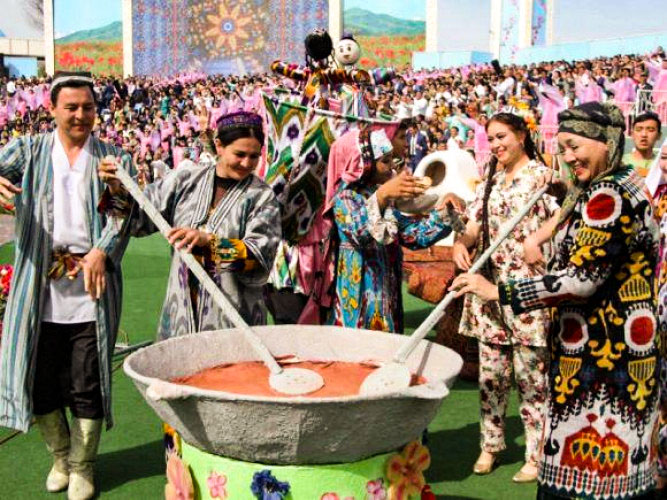
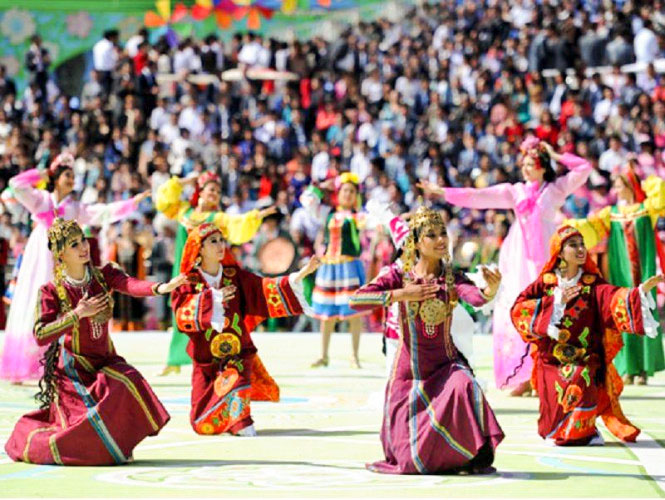
Uzbek farmers considered it especially auspicious to begin the first plowing on the eve of Navruz, preferably on a Wednesday, a day symbolically linked to abundance. The best oxen were selected for the occasion, and in the morning they were treated to steamed straw sprinkled with flour. Women prepared the “First Plowing Pilaf” (qo‘sh oshi), collecting grain and flour from each household—a communal contribution symbolizing wishes for a rich harvest, family well-being, and healthy children.
On this day, people sang:
Dehqon dala aylandi,
Ho‘kiz shoxi moylandi,
Omoch, mola, cho‘nka tish,
Bobo dehqon shaylandi.
Bugun bayram –Yilboshi,
Yilboshiga qo‘sh oshi,
Har ro‘zg‘orning himmati,
Palovmi yo so‘k oshi.
Momo quying go‘jani,
Tovoqni tut ichgani!
Dehqon bobo, bo‘sh kelmang,
Kuzda sanar jo‘jani.
The Farmer Walks the Field
The farmer walks the open land,
The oxen’s horns are oiled by hand,
The plow, the yoke, the sturdy teeth —
Grandfather Farmer’s set beneath.
Today’s a feast — the New Year’s Day,
For it, the Plowing Pilaf’s laid;
From every home, with willing cheer,
A dish — be it rich or humble fare.
Grandmother, pour the gravy bright,
Hold out the dish for us to bite!
Grandfather Farmer, don’t delay —
We’ll count the chicks come autumn’s day.
Before leading the plow into the field, elder women would sprinkle a pinch of flour between the oxen’s horns, saying: “May it be in whiteness, may we come to fullness! With your blessing, we’ll sift bowls full of flour!”
In every household, bo‘g‘irsoq (small pieces of dough fried in oil) were baked and shared with neighbors. It was believed that the more people partook in the treat, the richer the year’s harvest would be. The oil used to fry the bo‘g‘irsoq was then applied to the oxen’s horns, necks, and the plow’s blade. The ceremony concluded with the village elder offering a prayer for peace, tranquility, and abundance.