

State Museum of Arts of the Republic of Karakalpakstan named after I.V. Savitsky
State Museum of Arts of the Republic of Karakalpakstan named after I.V. Savitsky is entrusted with the mission of collecting, preserving, and exhibiting works of art, conducting scientific research, promoting cultural heritage, and fostering the development of art education in the region.
Main Activities The key areas of the I.V. Savitsky Karakalpak State Museum of Art include the preservation and exhibition of artworks, the development of national culture and art, and educational activities.
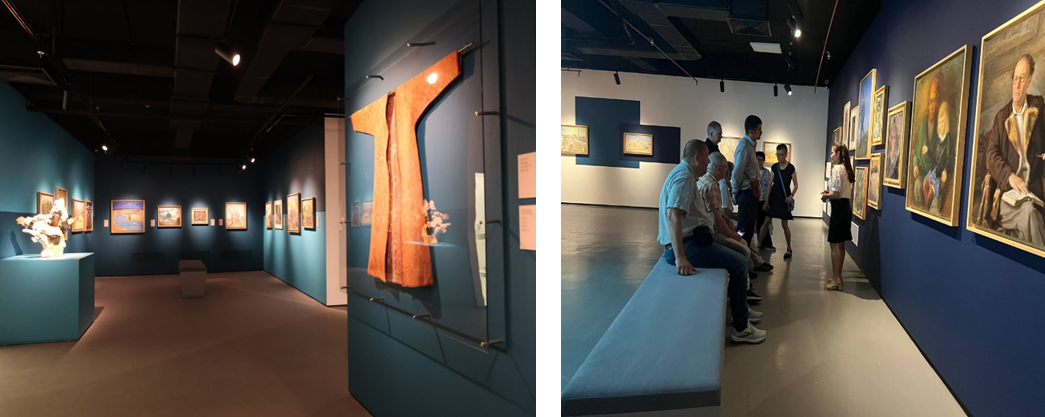
History The museum was established on February 1, 1966, and was named after I.V. Savitsky on December 7, 1984. It is located in the city of Nukus.
Paintings and Artifacts
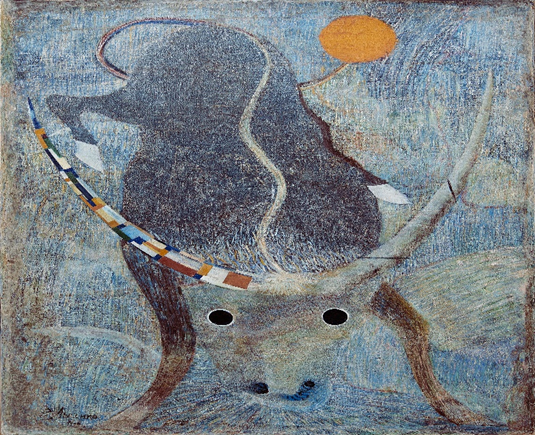
The painting “Bull” was created in 1929 by Uzbek artist Vasiliy Aleksandrovich Lisenko (1899–1974). It was purchased from the artist’s sister, Galina Aleksandrovna Lisenko. In 1991, the painting was exhibited at the Russian Museum in St. Petersburg, where it attracted the attention of the academic council and was selected as the main exhibit of the exhibition. It was featured on the cover of the exhibition booklet and posters. Later, the painting drew interest from Western art critics and journalists and began appearing on the covers of newspapers and magazines. The artwork depicts an angry bull in a simplified, stylized manner. The bull’s head and front legs are drawn frontally, its body at a diagonal angle from above, while the hind legs are shown in profile. The bull is rendered flat, without volume. This compositional approach reflects the influence of Neo-Primitivism, a trend popular among early 20th-century artists. The curved line over the bull’s back and its raised tail convey the sense of a creature ready to charge with full force. The painting invites deep reflection, drawing attention not only to art itself but also to history and the era in which it was created.
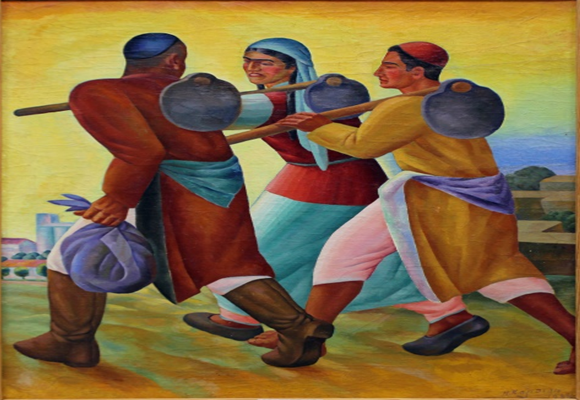
“Going to Work” - Nikolay Karakhan (1900–1970)
The painting by Uzbek artist depicts two male workers and one woman. They are dressed in traditional clothing and carry hoes on their shoulders as they head to work. The expressions on their faces convey seriousness and readiness for labor. The artwork is painted in bright colors — the morning sunlight, the green field, and the distant village serve as the background. The painting reflects the devotion of ordinary people to work, as well as the harmony of unity and movement.
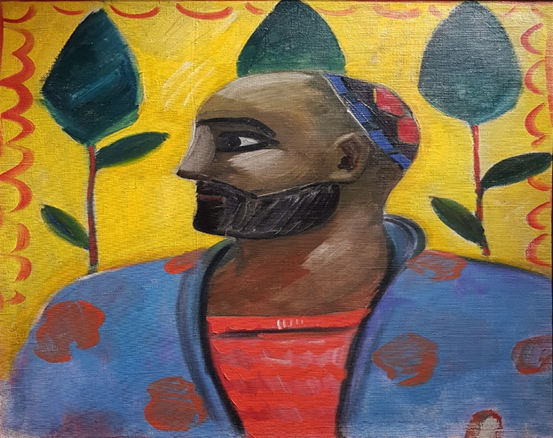
"Portrait of an Uzbek" — Orol Tansykbaev (1904–1974)
Orol Tansykbaev’s painting “Portrait of an Uzbek” (1934) belongs to the genre of portraiture and immediately draws attention to the central figure of the composition. The subject’s facial expression is serious yet calm. His large, focused eyes seem to establish direct eye contact with the viewer, creating a sense of a living dialogue between the observer and the portrayed figure. The almost imperceptible hair adds an aura of sanctity, purity, and spiritual elevation to the image.
The background of the painting is carefully conceived: behind the figure, three slender green trees are visible, symbolizing nature and freedom. The red semicircles in the background can be interpreted as the image of the sun — a source of life, warmth, joy, and creative energy.
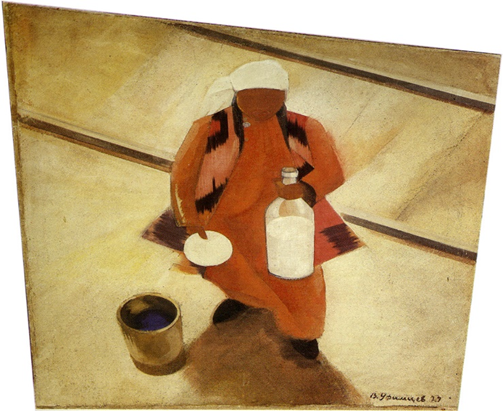
"To the Train" — Viktor Ufimtsev (1899–1964)
One of the most remarkable works created by Viktor Ufimtsev in 1929 is the painting “To the Train.” It vividly reflects the artist’s innovative and experimental spirit. The composition of the painting is strikingly unconventional: the upper part appears sharply cut at an angle, lending the image a sense of dynamism and tension. The railway tracks stretching into the distance enhance the feeling of motion and the passage of time, as if the viewer is drawn into the very stream of the unfolding scene.
The composition is extremely concise. Against an almost empty background, in the foreground, stands a Kazakh woman who has come to sell kumis—fermented mare’s milk—to the train passengers. Soft, slightly muted tones create an impression of sunlight diffused in the hot steppe air. The artist deliberately leaves the woman’s face unelaborated, as it is not essential to him. What matters is the idea, the gesture, the meaning of the moment. Ufimtsev, affirming his artistic credo, seems to say: “Explain—but do not depict.” Through this approach, the artist achieves profound expressiveness without excessive detail, conveying the poetry of simplicity and the philosophy of life in motion.
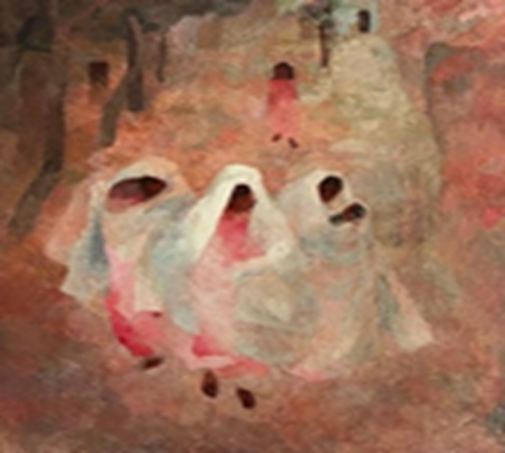
"Bukharan Women. Dawn" — Yelena Korovay (1901–1974)
Yelena Korovay’s painting “Bukharan Women (in Pink). Dawn” (1931–1932) is dedicated to the image of the East—its tranquility, dignity, and grace. The canvas depicts women in traditional Bukharan attire walking along a road against the backdrop of the morning light. Their white veils symbolize purity and modesty.
The color palette of the painting is exceptionally soft and harmonious. Shades of pink, reddish-brown, and white create a feeling of warmth and serenity, as if the viewer is witnessing the awakening of an ancient city. The movement of the figures, the fluidity of the fabric, and the interplay of light and shadow convey an Eastern refinement, inner calm, and cultural depth.
Everything in this work speaks of the continuity of tradition, the beauty and dignity of femininity. The painting is valuable not only for its aesthetic expressiveness but also for its reflection of the spirit of national culture—preserving the memory of its roots and the imagery of its past.
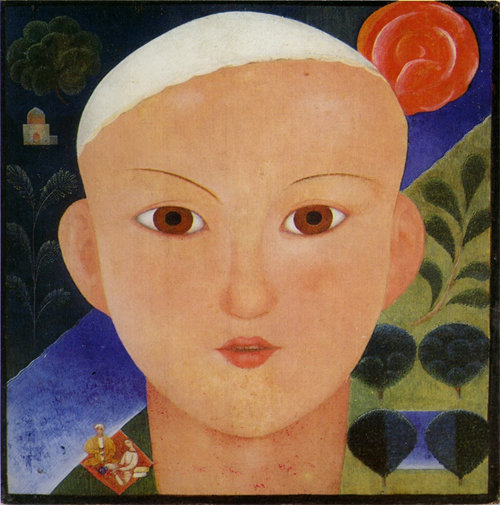
"The Path of Life" — Alexander Nikolaev (Usto Mumin) (1897–1957)
In Alexander Nikolaev’s (Usto Mumin’s) painting “The Path of Life” (1924), a young boy wearing a tubeteika (traditional cap) is depicted as a symbol of purity, innocence, and the beginning of life’s journey. Through the images of blossoming plants and green trees, the artist conveys the beauty and freshness of youth — a time when everything seems eternal. The motif of flowing water running through the composition symbolizes the continuous course of life, its transience — like a stream that cannot be contained.
On the left side of the painting, a cemetery is depicted — a reminder of the impermanence of existence and the fleeting nature of all things. The work is imbued with philosophical depth: the artist reflects on the human journey — from blossoming to fading, from beginning to completion — and does so with distinctive Eastern delicacy, transforming the cycle of life into a poetic meditation on time, memory, and the meaning of existence.
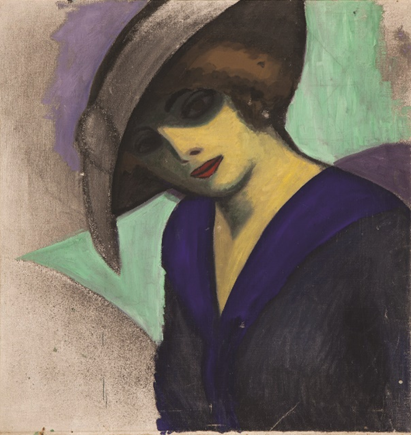
"Woman’s Head" — Nikolai Yefimovich Kuznetsov (1876–1970)
Nikolai Kuznetsov’s painting “Woman’s Head” (1916) is a refined example of a psychological portrait executed in the spirit of Expressionism. The canvas portrays a woman wearing a wide-brimmed hat, her head slightly tilted to one side. Her gaze is calm yet enigmatic, as though she harbors an unspoken secret. The artist employs an unusual color palette: the face is rendered in yellow-green tones, while the lips are accentuated with a deep red hue, adding a sense of drama and sensuality. The woman is dressed in a dark-blue gown, and the background — a blend of green, violet, and gray — evokes a soft haze and emotional depth. The expressionist manner, vivid contrasts, and daring color choices heighten the emotional impact of the work, revealing the heroine’s inner world — her subtlety, tension, and mysterious beauty.
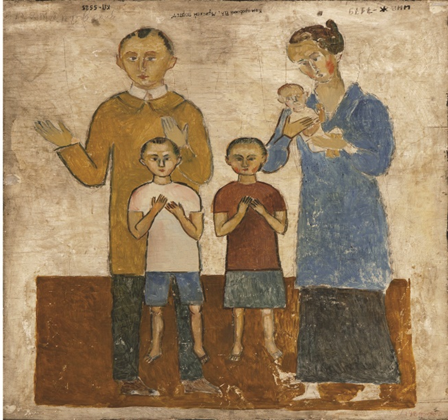
"Family Portrait" — Vladimir Alekseyevich Komarovsky (1883–1937)
Vladimir Komarovsky’s painting “Family Portrait” depicts a single family group. The canvas presents five figures: a father, a mother, and three children (one of them an infant). The father, dressed in a dark-yellow shirt, is shown with his hands raised. The mother, wearing a blue dress, holds the baby in her arms. Between them stand a daughter and a son, both with their hands placed over their chests. Their clothing is simple yet colorful: the son wears white and blue, while the daughter is dressed in red and blue. The style of the work is simplified and symbolic; the human figures are rendered in a stylized manner, outside the conventions of realism. The background is neutral and smooth, directing the viewer’s attention to the characters’ facial expressions and gestures. The painting conveys the universal themes of love, family, and unity.
Shartuyme
Shartuyme is a chest ornament shaped to symbolize the four cardinal directions. Large carnelian stones are set in the center and at each of the four corners, surrounded by smaller turquoise inlays. Bells and leaf-shaped pendants hang from the lower chain, while two hooks at the top allow the ornament to be attached to clothing.
State Museum of Arts of the Republic of Karakalpakstan named after I.V. Savitsky
The permanent exhibition of the mueum presents the rich heritage of Russian and Turkestan avant-garde, as well as works of national and regional art. A special place is given to collections of decorative and applied art and archaeological artifacts that reflect the centuries-old cultural history of Karakalpakstan.
You can explore the exhibition halls, renewed between 2017 and 2020, on the official website: https://savitskiy.uz/
The museum features a research library, a conference hall, a souvenir shop, and a café.
Guided tours are available in Karakalpak, Uzbek, Russian, German, and English.
Opening hours: daily from 09:00 to 18:00 (without a lunch break).
Monday — closed.
Address: 230100, Republic of Karakalpakstan, Nukus, 52 T. Kaipbergenov Street
Contacts: Phone (for inquiries and guided tours): +998 (61) 222-61-28
Telegram channel: https://t.me/museumsavitsky
Admission fees:
For citizens of Uzbekistan:
Adults — 20,000 UZS
Students — 16,000 UZS
Children under 12 — 8,000 UZS
For foreign visitors:
Adults — 100,000 UZS
Students — 80,000 UZS
Children under 12 — 60,000 UZS